Healthcare
Whitepaper: The role of clinical nutrition in hospital care

Lower household income has been consistently associated with poorer diet quality across the world.
Studies also show that supporting women is the most effective way to reduce the risk of hunger within a family. In fact, for every dollar made by a man, a woman earns 77 cents, and 90% of that income is invested on their family, compared to 40% for men.
Because of this, our unique philanthropic cause Stop Hunger, consciously aims to empower women around the world.
Two Stop Hunger projects in Latin America are focusing on just that, empowering women from disadvantaged suburbs with knowledge and training to enable them to better support their families boost the nutrition of a whole community.
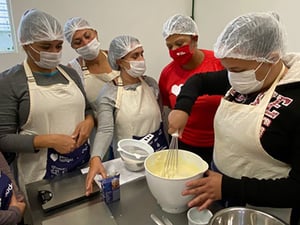
The ‘School Kitchen’ is a training course for vulnerable aspiring female cooks, kitchen assistants and culinary entrepreneurs from the community of Grajaú, Sao Paulo, Brazil. Grajau is one of the most deprived areas in the city with one of the highest rates of domestic violence against women.
The training course, designed to host 4 classes of 12 students per year, has just completed its 8th intake students. The course last for five weeks and covers topics such as food safety, business model, interview techniques, sales and nutrition as well as how to make certain dishes, delivered through a mix of virtual and in-person classes.
The initiative was set up in partnership with the local NGO Anchieta Grajau Institute (IAG), local Sodexo client Electrolux together with Electrolux Food Foundation as well as Stop Hunger and Sodexo.
50% income generation rate
Since the beginning of the program, 29 women have found employment. Eight of them are now employed by Sodexo and 10 women have started their own business.
A double benefit of the project is that it’s provided a new kitchen and dining hall for IAG which enables more children to be assisted by the NGO: they’ve been able to double the number of meals served (from 1,000 meals to 2,000 meals daily). IAG has been supporting families in the region for 25 years and hosts around 600 2 – 18-year-olds daily. At the time we started the project, 665 children were on a waiting list to be assisted by the NGO.
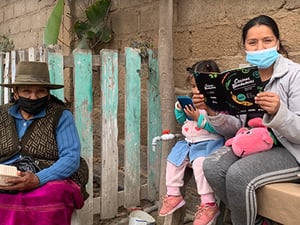
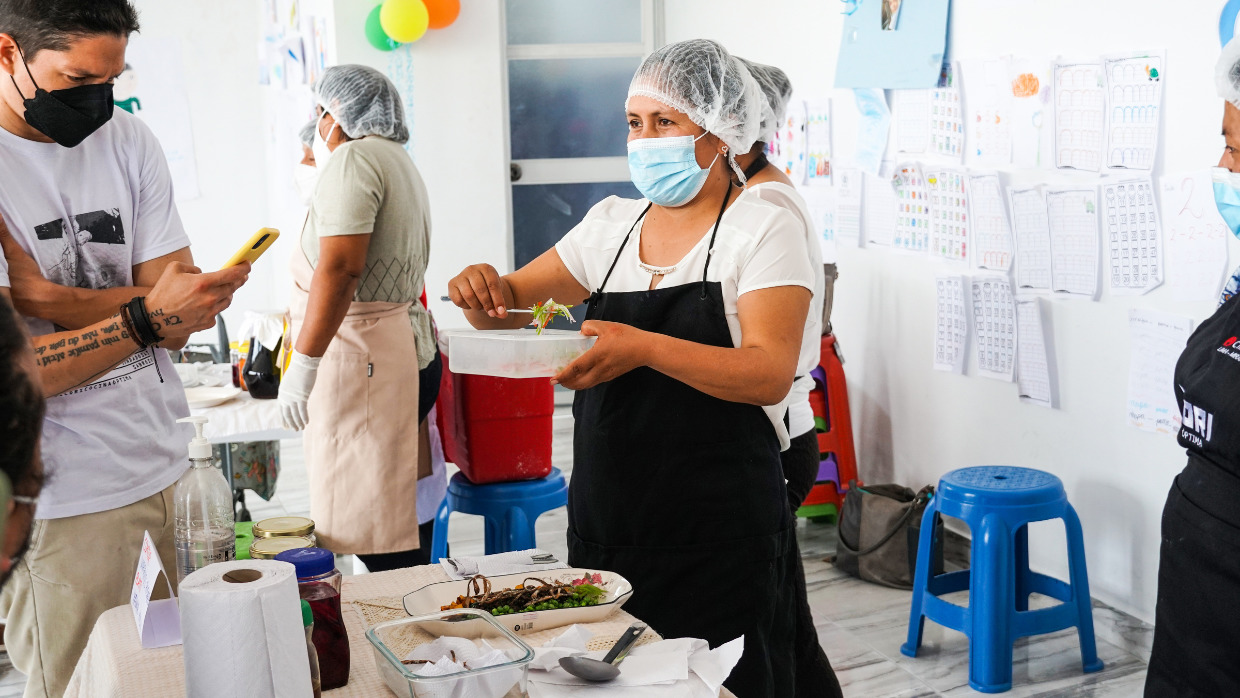
Kind Kitchens (Cocinas Bondadosas) is a food program designed to help hundreds of women from Lurin, a disadvantaged suburb in south Lima, Peru, prepare quality food without waste whilst also improving the nutrition of the wider community.
Traditional collective kitchens (comedores populares) are a vital part of the community in Peru. Run by local female volunteers, they support the most vulnerable families with food support provided by the state through the Food Supplementation Program.
Kind Kitchens consists of virtual classes, a cookbook, nutritional health measurements and a competition where the participants demonstrate their knowledge. The program was co-created by famous Peruvian chef Palmiro Ocampo’s NGO “Ccori Cocina Óptima”, Stop Hunger and Sodexo.
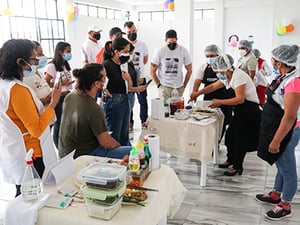
So far more than 300 female volunteers from 22 collective kitchens have taken part in 12 virtual culinary workshops spanning six weeks, learning to prepare delicious, balanced meals on a limited budget by making the most of food and leftovers. On average each virtual workshop has had 355 attendees. 140 copies of the cookbook, based on the cookbook of a famous Peruvian chef, were distributed to the collective kitchens as well as being shared digitally.
51 new virtual workshops are planned over the next two years as well as expanding the program to an additional 32 collective kitchens and adding new recipes to the cookbook.
The success of the program is measured in participation levels of the volunteers in the program as well as from the health of the children attending the collective kitchens. Levels of anaemia and malnutrition in children were monitored across seven kitchens and a survey was conducted at the beginning and end of the program to monitor the consumption of iron rich food. There was an increase in iron levels of 13% for those consuming iron-rich food two to three times a week and an increase of 20% for those consuming foods rich in vitamin C.
Find out more about Stop Hunger