Sodexo launches its 2030 growth acceleration plan
At the Board of Directors meeting held on October 22, 2026, chaired by Sophie Bellon, the Board approved the consolidated accounts of Sodexo for the fiscal year ended August 31, 2026.


Sodexo launches its 2030 growth acceleration plan

Q3 Fiscal 2026 revenues above expectations; focus on execution

First half Fiscal 2026 results: reset in motion with first management actions; full-year guidance updated
Fiscal 2026 was a year of reset and action for Sodexo. We ended the year with stronger organic growth than expected, supported by resilient demand and a continued focus on execution across the organization. This is encouraging. However, our overall performance remains below the full potential of the Group.
Three months on from the Investor Update, we have made progress on rebuilding our foundations: commercial capabilities are strengthening, the new account-management model is being implemented, simplification actions are underway in all geographies, and clearer performance expectations and accountability have been established across the organization.
In line with Shift & Grow 2030, we will continue in Fiscal 2027 the work underway to restore our competitiveness. I recognize the effort this transformation requires and want to thank our teams around the world for their professionalism and continued commitment to our clients and consumers. Our priorities are clear, and we remain focused on delivering the commitments we have made.

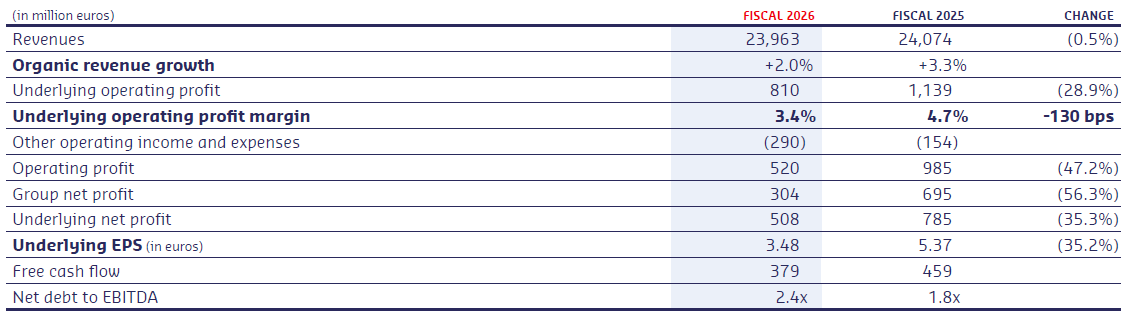
Fiscal 2026 consolidated revenues amounted to 24.0 billion euros, down -0.5% year-on-year. Organic revenue growth of +2.0% and a positive net contribution from acquisitions and disposals of +0.5% were offset by a negative currency impact of -3.0%, mainly due to the depreciation of the U.S. dollar.
Organic revenue growth was supported by pricing of around +2.4% and like-for-like volume growth of around +0.6%, including strong Sodexo Live! activity. These drivers were partly offset by a circa -0.7% headwind from the previously disclosed contract reclassification in North America Business & Administrations, along with slightly negative net new business.
By service line, organic revenue growth was +1.6% in Food services and +2.9% in Facilities Management services.
By geography:
For Fiscal 2026, client retention1 was 94.4%, while development1 reached 7.7%. Development included the previously announced global contract with Meta, which will ramp up progressively during Fiscal 2027.
Underlying operating profit amounted to 810 million euros and the underlying operating profit margin was 3.4%, compared with 4.7% in Fiscal 2025. The decrease reflected charges and provisions arising from the review of certain contracts and assets, accelerated investment to strengthen the Group’s capabilities, and operational factors.
Other operating income and expenses represented a net expense of 290 million euros, compared with 154 million euros in Fiscal 2025. The increase mainly reflected higher restructuring costs related to the Group’s transformation, together with specific asset-related and pension-related items, partly offset by a disposal gain.
Net financial expense increased to 137 million euros, compared with 88 million euros in Fiscal 2025, mainly reflecting higher financing costs.
Group net profit amounted to 304 million euros, compared with 695 million euros in Fiscal 2025. Underlying net profit was 508 million euros, compared with 785 million euros in the prior year.
Free cash flow amounted to 379 million euros, compared with 459 million euros in Fiscal 2025. The decrease mainly reflected lower operating profit, higher interest payments and higher capital expenditure, driven by client investments associated with contract renewals and new business wins. These effects were partly offset by the absence of the exceptional tax payment recorded in the prior year and a positive working capital contribution, supported by good collections as well as favorable timing and one-off effects. Net capital expenditure represented 2.5% of revenues, compared with 2.0% in Fiscal 2025.
As of August 31, 2026, net debt was 2.9 billion euros and the net debt to EBITDA ratio was 2.4x, compared with 1.8x at the end of Fiscal 2025. The increase in the ratio primarily reflected the lower EBITDA base in the context of the Group’s operational reset.

Consistent with Shift & Grow 2030, Sodexo maintained a selective and disciplined approach to M&A, focused on targeted bolt-on acquisitions in key activities and markets, while continuing to manage its portfolio actively.
On August 26, 2026, Sodexo priced a dual-tranche euro-denominated bond issuance totaling 1.1 billion euros, which settled on September 2, 2026. The proceeds will be used for general corporate purposes, including the redemption of the Group’s outstanding bonds totaling 800 million euros and due in April 2027.
The first year of Better Tomorrow 2028, Sodexo’s sustainability roadmap, delivered tangible progress across its people and environmental commitments.
Together, these achievements demonstrate how Sodexo is embedding sustainability into its operations to strengthen its value proposition and support its clients’ own sustainability ambitions.
On July 1, 2026, Agnès Park joined Sodexo as Group Chief Human Resources Officer and a member of the Global Executive Team, with a particular focus on workforce management, talent development and strengthening a high-performance culture as part of Shift & Grow 2030.
Subject to the renewal of her term as Director at the Annual Shareholders Meeting on December 16, 2026, the Board is proposing the appointment of Nathalie Bellon-Szabo as Chairwoman. She would succeed Sophie Bellon, who has chaired the Board since 2016. Upon her appointment, Nathalie Bellon-Szabo would step down from her operational responsibilities as Chief Executive Officer of Sodexo Live! Worldwide.
Subject to the renewal of her term, Sophie Bellon would remain a Director of Sodexo. She would replace Nathalie Bellon-Szabo as a member of the Nominating Committee and would be appointed to the Compensation Committee. Nathalie Bellon-Szabo would remain a member of the Sustainability Committee. Sophie Bellon will also become Chairwoman of the Management Board of Bellon SA.
The Board will also propose the renewal, for three-year terms, of Gilles Pélisson and Federico J. González Tejera. Gilles Pélisson would continue to serve as Lead Independent Director and Chair of the Nominating Committee. He would also be appointed to the Compensation Committee and would remain a member of the Sustainability Committee. Federico J. González Tejera would remain a member of the Compensation Committee. Cathy Martin and Olivier Marchand have been reappointed as Directors representing employees.
If all proposed renewals are approved, the Board will continue to comprise 12 members. Excluding Directors representing employees, 40% of its members will be women and 60% will be independent.
The Board proposes an ordinary dividend of 1.74 euros per share, in line with the Group's policy of a 50% payout ratio based on underlying net income. The dividend will be submitted for approval at the Annual Shareholders Meeting on December 16, 2026. Subject to approval, the shares will trade ex-dividend from December 18, 2026, and the dividend will be paid on December 22, 2026.
In line with the first phase of Shift & Grow 2030, focused on rebuilding competitiveness, Sodexo confirms the Fiscal 2027 outlook presented at its Investor Update in July 2026:
From Fiscal 2028 onwards: acceleration phase with progressive benefits from these actions, supporting improved growth, profitability and returns.
For Fiscal 2030, Sodexo expects to deliver:
Sodexo will hold a conference call (in English) today at 9:00 a.m. (Paris time), 8:00 a.m. (London time) to comment on these Fiscal 2026 Results.
To join the call:
Access Code: 07 26 13
A live audio webcast is also available on www.sodexo.com.
The press release, presentation and webcast will be available on the Group website www.sodexo.com in both the “Newsroom” section and the “Investors – Financial Results” section.
1Retention and development are based on the annualized revenue of contracts gained or lost during the period, irrespective of their start dates, and exclude cross-selling. They therefore do not represent their contribution to revenue in the fiscal year.