






Uniting for better food, better health, and a better planet 

  • Food
  • Published on Oct. 02, 2025

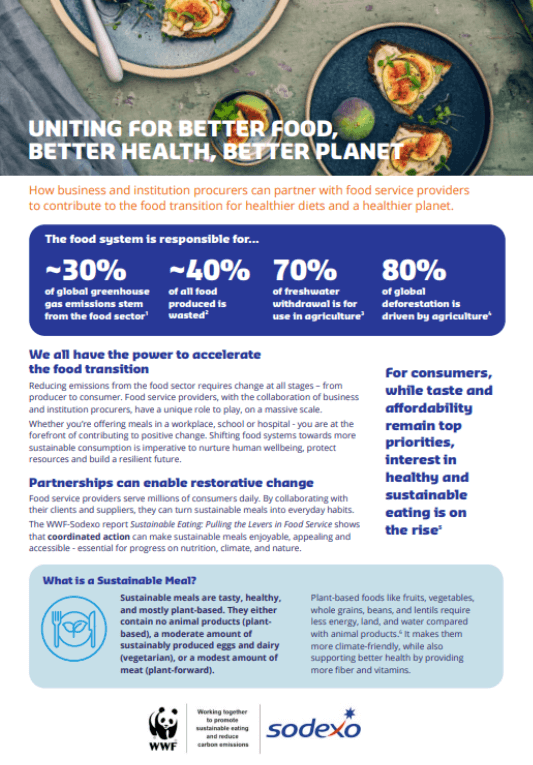
The global food system is a major driver of climate and environmental pressures: it accounts for around 30% of greenhouse gas emissions, 40% of food waste, 70% of freshwater withdrawals, and 80% of deforestation.  

At the same time, consumers are increasingly interested in healthier and more sustainable diets, though affordability and taste remain primary influences on food choice.

Food service providers, in partnership with business and institutional procurers, can play a decisive role in transforming diets.  

Through the millions of meals they serve daily, they have the capacity to make sustainable eating mainstream, defined as tasty, healthy, mostly plant-based meals, with moderate amounts of sustainably sourced dairy, eggs, and meat.

Three levers of change:

Establishing shared sustainability and health goals with providers. Embedding these ambitions into governance and contracts. 

Align Commitments

Establishing shared sustainability and health goals with providers. Embedding these ambitions into governance and contracts. 
UFBF-1

Contracting for Impact

Making sustainability integral to contracts by defining measurable KPIs, clear delivery terms, and accountability mechanisms. Collaborating on delivery models that balance affordability with sustainability. 

Guiding Consumer Choices

Using behavioral nudges such as recipe naming, meal placement, and default plant-based options. Engaging staff in promoting sustainable options and collecting data to refine strategies. 

Uniting for better food, better health, better planet

Our report ‘Uniting for better food, better health, better planet’ explores why businesses and institutions should partner with food service providers to accelerate the shift to diets that are better for both human and planetary health!

We can choose to simultaneously improve our own health and the health of the planet. Although diets will differ across the world, choices richer in plants and less dependent on livestock products can help us thrive

kate-profile
Kate NorgroveExecutive Director of Advocacy and Campaigns, WWF-UK

We have the opportunity to nourish human and planetary health through widespread adoption of healthy and sustainable diets. Action is needed to make the food we eat better for ourselves and the planet:

  • Healthy and sustainable diets must become the norm, not the exception.
  • Food procurers must co-create solutions with providers, embedding accountability and measurable goals into contracts.
  • By aligning commitments, contracting for impact, and guiding consumer choices, the food sector can deliver systemic, sector-wide transformation.

We have partnered with the WWF since 2010, working to improve our sustainable food offers and purchasing practices. 

Our industry is fueled by passion and purpose. At Sodexo, we push boundaries because the health of our consumers and our planet – and the role each of us plays in protecting both – are what truly matter.

mouna-profile
Mouna Fassi DaoudiGlobal Chief Sustainability Officer, Sodexo

Key figures

farmer

of global greenhouse gas emissions stem from the food sector

30%

increase in plant-based selections achieved through Sodexo’s ‘DefaultVeg’ strategy in US university dining halls pilot sites.

58.3%

of all food produced globally is wasted

40%

sustainable-cooking

reduction in average food carbon impact achieved through Sodexo and Cytiva’s co-designed menus.

59%

of freshwater withdrawal is for use in agriculture

70%

of global deforestation is driven by agriculture

80%